


Efficiency of RPP MAPF PE 5044 S application in External Thermal Insulation Composite Systems (ETICS)
ADDITIV PLUS LLC, G.V. Andriyanov, Technical Manager
About company
ADDITIV PLUS LLC is a dynamically developing company engaged in the production and supply of a wide range of chemical additives for the manufacturing of dry mixes and paints & coatings. The company operates a state-of-the-art Technical Center equipped with a comprehensive range of testing equipment, including unique, full-scale environmental chambers for ETICS testing. Top-tier experts in the field of dry mortars and coatings, combined with our own accredited laboratory, enable us to quickly and efficiently select chemical components for your business, as well as develop and test a broad range of formulations.
Currently, the company’s product portfolio includes everything required for the manufacturing of various dry construction mix types: cellulose ethers and redispersible polymer powders under our own trademark MAPF©, thickeners based on polyacrylamide and diutan gum, plasticizers, rheological additives, and others.
Introduction
To improve the thermal and acoustic insulation of exterior walls, a “wet” system with simultaneous facade insulation (ETICS) is used. Such a system consists of insulation, reinforced, and protective-decorative layers. The adhesive layer is critical for the durability of the reinforcing layer, and its quality must be confirmed by laboratory test results.
Modern formulations used in insulation systems can be universal, meaning they can also be used to create the reinforced layer. The requirements for cement-bound adhesive, base, and leveling mortars for ETICS are outlined in the GOST R 54359-2017 standard:
Requirements for fresh mortar:
– good workability for both machine and manual application;
– extended open time
Requirements for hardened mortar:
– tensile adhesive strength (adhesion) to EPS at the design age of no less than 0.1 MPa;
– the failure mode must occur through the expanded polystyrene body;
– tensile adhesive strength (adhesion) to EPS at the design age after water immersion for 48 hours of no less than 0.08 MPa;
– water absorption of no more than 15%;
– shrinkage deformation of no more than 2.0 mm/m;
– water vapor diffusion resistance of more than 0.15 m²·h·Pa/mg.
To achieve the established standards, highly effective polymer additives are used in formulation development, including redispersible polymer powders (RPPs).
Research Objectives and Targets
In this study, a technical evaluation was conducted on the use of the MAPF TM PE 5044 S RPP in comparison with competing products in the Russian Federation market for ETICS adhesive and base coat mortars. All tests were performed at the Technical Center of ADDITIVE PLUS.
Domestically produced RPPs, Chinese-manufactured RPPs, and a European RPP sample were tested as analogues to MAPF PE 5044 S.
MAPF® PE 5044 S is a water-redispersible vinyl acetate-ethylene copolymer powder with good resistance to saponification. A high ethylene content imparts softness and elasticity to the polymer. Its glass transition temperature is below freezing point, which allows MAPF PE 5044 S to be used in formulations for low-temperature applications, in the so-called “winter” products.
| Sample name | Polymer base | Minimum film-forming temperature, MFFT, °C | Ash content, 900 °C, wt. % |
| Domestic RPP sample No. 1 | VAc-others | 4 | 11,8 |
| Domestic RPP sample No. 2 | VAc-others | 4 | 12,1 |
| Chinese-produced RPP No. 3 | VAc-E | 4 | 12,6 |
| Chinese-produced RPP No. 4 | VAc-E | 4 | 12,7 |
| European-produced RPP No. 5 | VAc-E | 0 | 10,7 |
| RPP MAPF 5044 S № 6 | VAc-E | 0 | 9,8 |
MFFT (Minimum Film-Forming Temperature) is an important characteristic of a polymer binder and determines the temperature at which film formation is possible. The lower this temperature, the wider the application range of the RPP.
Standard formulations based on Portland cement type CEM I 42.5 H were used to determine the technical characteristics of the compounds (see Table 2).
| Material description | Weight, g | |||||
| № 1 | № 2 | № 3 | № 4 | № 5 | № 6 | |
| Portland cement CEM I 42.5 H | 280 | 280 | 280 | 280 | 280 | 280 |
| Filler, marble flour, 100 μm | 70 | 70 | 70 | 70 | 70 | 70 |
| Aggregate, quartz sand, fraction 0–0.63 mm | 628 | 628 | 628 | 628 | 628 | 628 |
| Domestic RPP sample No. 1 | 20 | |||||
| Domestic RPP sample No. 2 | 20 | |||||
| Chinese-produced RPP No. 3 | 20 | |||||
| Chinese-produced RPP No. 4 | 20 | |||||
| European-produced RPP No. 5 | 20 | |||||
| RPP т.м. MAPF 5044 S № 6 | 20 | |||||
| HPMC MAPF CE 23708 | 2,0 | 2,0 | 2,0 | 2,0 | 2,0 | 2,0 |
| Water/Solid ratio, g/kg | 210 | 210 | 210 | 210 | 210 | 210 |
The most important characteristics for ETICS adhesive and base coat mortars are adhesion to concrete, adhesion to expanded polystyrene (EPS), and adhesion to expanded polystyrene after water immersion. Evaluating the failure mode between the mortar and the substrate, as well as the adhesive contact area on the expanded polystyrene, is also of significant importance.
Experimental results
Figure 1 shows the 28-day tensile bond strength to a concrete substrate for the evaluated formulations.
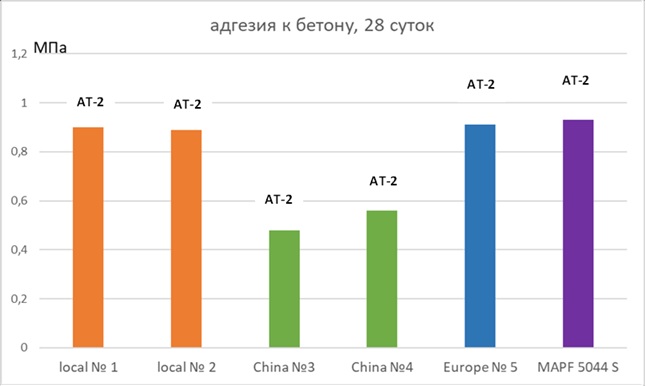
As illustrated in Figure 1, samples 1, 2, 5, and 6 demonstrated the highest tensile strength values.
The most challenging parameters to achieve for such formulations are the tensile bond strength of expanded polystyrene (EPS) to the substrate, including after water immersion. In this case, not only the measured pull-off strength value is important, but also the failure mode of the sample. Proper selection of the polymer binder plays a key role in achieving the required performance, and MAPF PE 5044 S successfully copes with this task.
Figures 2 and 3 present the test results for the tensile adhesive strength of the formulations when bonding expanded polystyrene (EPS).
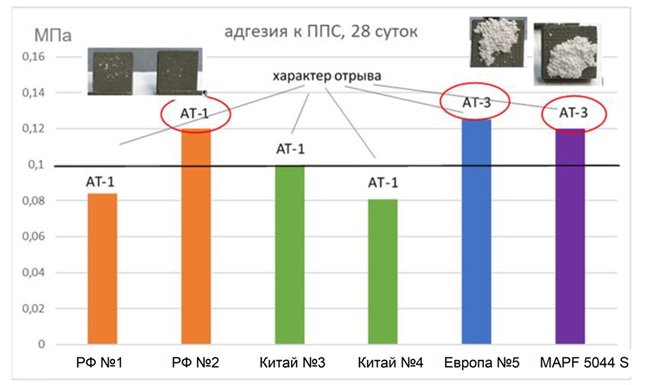
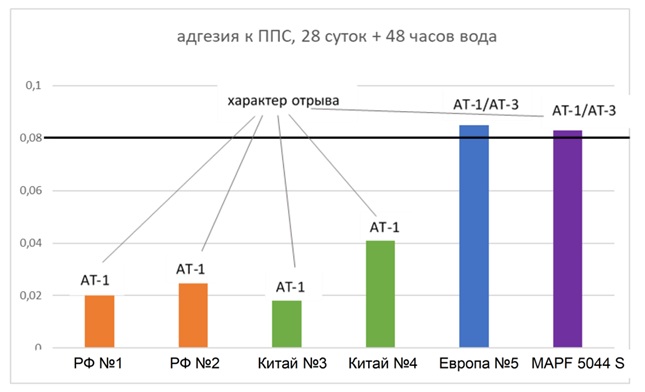
As seen from the test results, among all the tested RPP samples, only MAPF PE 5044 S and one European-manufactured RPP fully comply with the requirements of the GOST R 54359-2017 standard.
Conclusions based on the research results:
1. The application of MAPF PE 5044 S ensures that base coat plaster formulations comply with the requirements of GOST R 54359-2017 for the “tensile adhesive strength” parameter, including the “tensile bond strength to EPS at 28 days + 48 hours of water immersion” indicator;
2. The application of MAPF PE 5044 S at a dosage of 2.0% in the base coat plaster formulation ensures the required failure mode through the substrate body — AT-3 (adhesive failure through the substrate body);
3. The minimum film-forming temperature (MFFT) of MAPF PE 5044 S, which is 0°C, allows it to be recommended for use in adhesive and base coat plaster formulations for facade insulation works at low ambient air temperatures.
References
- Dubrovina G.G., Goncharov Yu.A., Gubskaya A.G., Nazarov D.V. Cement Dry Construction Mixes. Production and Practical Manual – Minsk: Kovcheg, 2015 – 248 p.
- Builder’s Handbook: Full Complex of Construction and Finishing Works for Commissioning a House / A.G. Borisov – M: AST: Astrel, 2008 – 327 p.
- Materials Science in Construction: Textbook for Higher Education Institutions / edited by I. A. Rybyev – M: Publishing Center “Academy”, 2008 – 528 p.
- Dry Construction Mixes: Handbook – M: Stroyinform, 2007 – 828 p.
- “GOST R 54359-2017. National Standard of the Russian Federation. Cement-bound adhesive, base, and leveling mortars for external thermal insulation composite systems with rendering/plastering systems. Specifications” (approved and enforced by Order of Rosstandart dated November 23, 2017 No. 1809-st) (as amended on December 24, 2020)